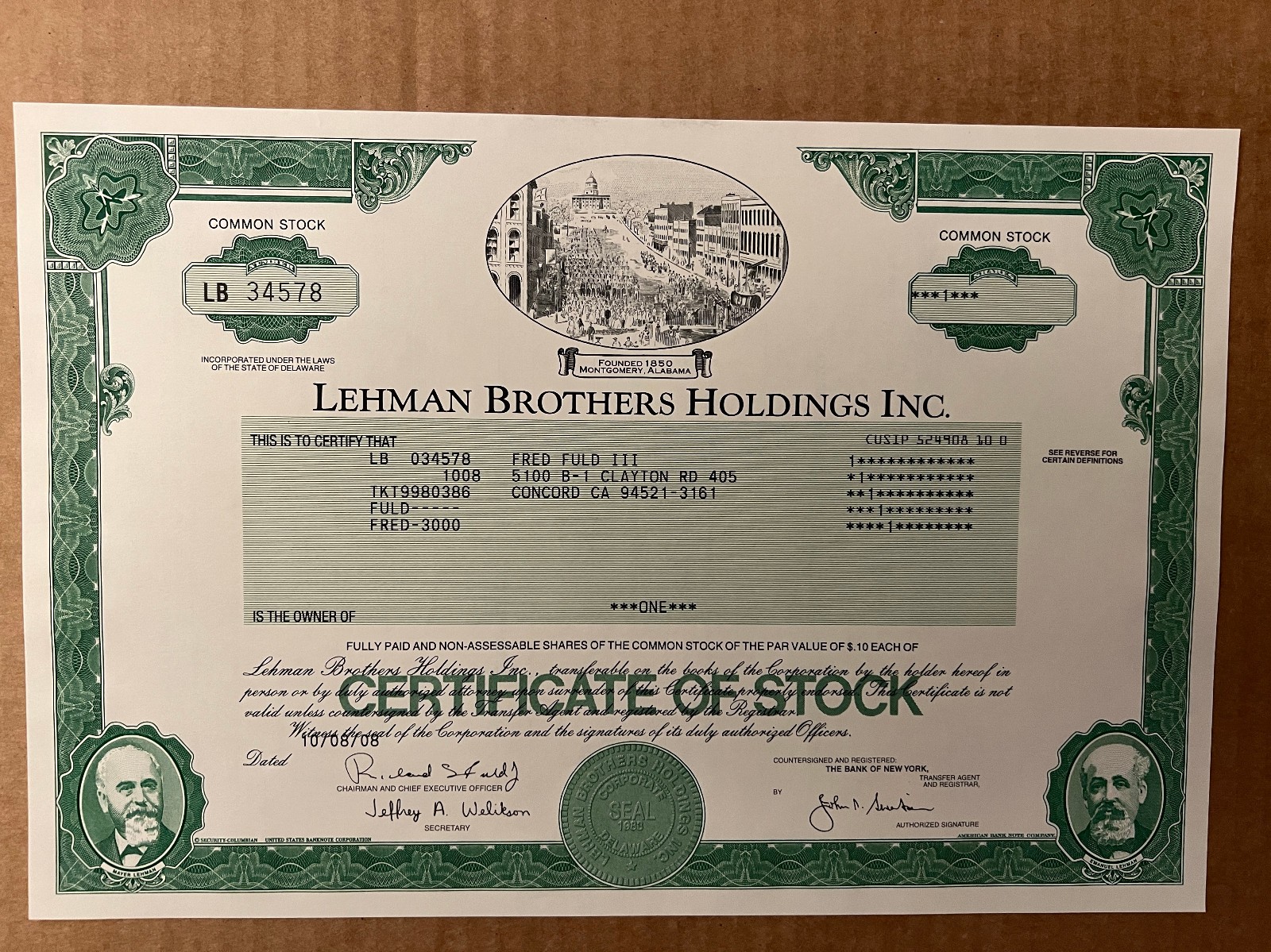
Lehman Brothers 2008 Stock Certificate - Original Stock Certificate
This listing offers a Lehman Brothers 2008 stock certificate in extremely fine condition. It is categorized under Coins & Paper Money and may appeal to collectors of historical financial memorabilia, especially items related to the 2008 financial crisis. Free shipping is included with the purchase. Check the listing for details.


| Location | Concord US |
| Shipping | Free shipping (check listing for details) |
| Seller |
antiquestocks*com
100.0% positive · 1920 feedback
|
| Listing | FixedPrice · Active |
| Start time | 2025-11-30T01:36:06.000Z |
| Country of Origin | United States |
| Circulated/Uncirculated | Circulated |
| Type | Stock |
Lehman Brothers stock certificate Original Authentic GenuineDated 2008 A victim of the 2007-2008 financial crisis stock market crash!!If you run your finger along the company name on the certificate, you can feel the intaglio raised-print printing.The history of Lehman Brothers spans more than 150 years and reflects the rise, transformation, and collapse of one of Wall Street’s most iconic firms. Here's a chronological overview: 🧱 Founding and Early Growth (1850s–1900s) 1850: Lehman Brothers was founded in Montgomery, Alabama, by Henry Lehman, a German Jewish immigrant. His brothers Emanuel and Mayer Lehman joined in 1855, creating Lehman Brothers. Initially, the firm was a general merchandise business, but soon it shifted into cotton trading, a dominant commodity in the South. After the Civil War, Lehman moved its headquarters to New York City and became increasingly involved in banking and finance, especially in commodities and trading. 📈 Rise as a Wall Street Power (1900s–1960s) In the early 20th century, Lehman Brothers transitioned into investment banking, helping to underwrite and finance companies like Sears, Roebuck, and other industrial giants. The firm played key roles in the rise of retail, aviation, and film industries, backing companies like Pan American World Airways and Paramount Pictures. During the Great Depression, it survived but was weakened, and it was eventually led by Robert Lehman, who stabilized the firm and led it until his death in 1969. 🏦 Acquisition and Restructuring (1970s–1980s) After Robert Lehman's death, the firm struggled and lacked clear leadership. In 1984, Lehman Brothers was acquired by American Express, becoming part of Shearson Lehman/American Express. During this period, it was merged with Shearson Loeb Rhoades, and then with E.F. Hutton, forming Shearson Lehman Hutton. 🔄 Independence Restored (1994) In 1994, American Express spun off Lehman Brothers as an independent public company again, under the name Lehman Brothers Holdings Inc. 💹 Rapid Growth and Risk (1990s–2007) In the late 1990s and 2000s, Lehman expanded heavily into mortgage-backed securities, real estate, and high-risk derivatives. By the mid-2000s, it was one of the largest underwriters of subprime mortgages and had substantial exposure to the real estate bubble. In 2007, Lehman reported record profits and bonuses, but warning signs were already emerging as housing markets began to collapse. 💥 Collapse and Bankruptcy (2008) In 2008, as the U.S. subprime mortgage crisis intensified, Lehman suffered catastrophic losses in its real estate portfolio. Efforts to find a buyer (including talks with Barclays and Bank of America) failed. On September 15, 2008, Lehman Brothers filed for Chapter 11 bankruptcy protection, listing $613 billion in debt—the largest bankruptcy in U.S. history. The collapse of Lehman Brothers triggered a global financial panic, accelerating the 2008 financial crisis.