Galton Board: Simple Edition
Check the listing for details.


| Location | Casper US |
| Shipping | Free shipping (check listing for details) |
| Seller |
taytoy19627
100.0% positive · 1574 feedback
|
| Listing | FixedPrice · Active |
| Start time | 2026-01-21T21:03:20.000Z |
| Subject | Mathematics, Physics, Statistics |
| Language | English |
| Model Name | Galton Board: Simple Edition |
| Item Package Quantity | 1 |
| Brand | Ifa.Com |
| Part Number | Ifa-Sgb2025 |
| Educational Objective | Logical Thinking, Critical Thinking, Problem Solving Skills, Stem |
| Number Of Boxes | 1 |
| Safety Warning | May Cause Excitement |
| Theme | Mathematics |
| Manufacturer Minimum Age | 60.0 |
| Target Audience Keyword | Unisex Adult, Unisex Children |
| Material | Plastic |
| EAN | 0783495901006 |
| ISBN | 0783495901006 |
| Package Dimensions LxWxH | 7.01x4.76x1.69 Inches |
| Weight | 0.66 Pounds |
| UPC | 783495901006 |
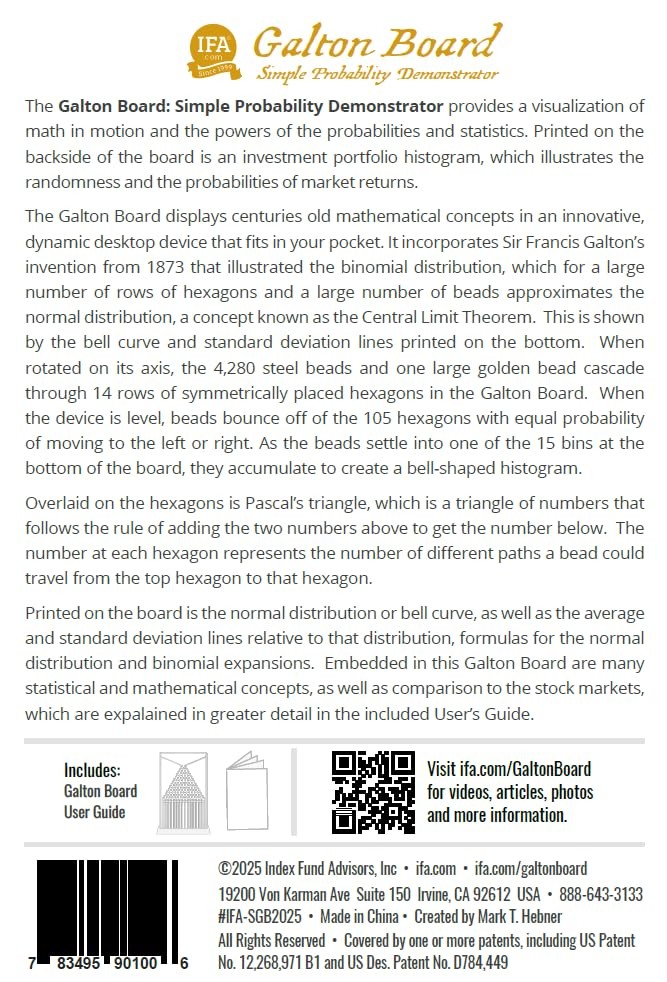
Perfect present for science and investor enthusiasts. User Guide available in 9 languages on Galtonboard dot com. This is the original modern Galton Board, not a knockoff. The Galton Board: Simple Edition with Pascal’s triangle is a 6.5 inches tall, 4.5 inches wide and 1/4 inch thick without the removeable silicone base (150 mm x 95 mm x 7 mm) probability demonstrator providing a visualization of math in motion and the powers of the probabilities and statistics. Printed on the backside of the board is a theoretical investment portfolio histogram, which illustrates the randomness and the probabilities of market returns. The removable silicone base allows the board to stand upright on a desk or table. If you remove the 1.25" thick base, the remaining 1/4" thick board fits in your shirt or suit coat pocket making it the ultimate geek accessory. The Galton Board displays centuries old mathematical concepts in an innovative, dynamic desktop device. It incorporates Sir Francis Galton’s (1822-1911) invention from 1873 that illustrated the binomial distribution, which for a large number of rows of hexagons and a large number of beads approximates the normal distribution, a concept known as the Central Limit Theorem. He was fascinated with the order of the bell curve that emerges from the apparent chaos of beads bouncing off of pegs in his board. According to the Central Limit Theorem, more specifically, the de Moivre (1667-1754) – Laplace (1749-1827) theorem, the normal distribution may be used as an approximation to the binomial distribution under certain conditions. When the Galton Board is turned upside down, the beads flow into the top reservoir. When turn back over and held on a level surface, the 4,280 steel beads and one large golden bead cascade from the reservoir through 14 rows of symmetrically placed hexagons in the Galton Board. When the device is level, beads bounce off of the 105 hexagons with equal probability of moving to the left or right. As the beads settle into one of the 15 bins at the bottom of the board, they accumulate to create a bell-shaped histogram. Flipping the Galton board is like tossing 59,920 coins in about 2 seconds. A bead representing fourteen heads in a row would land in bin and a bead representing no heads (fourteen tails) would land in bin . Printed on the top of the board are formulas for the normal distribution and the binomial expansion. Printed on the lower part of the board is the normal distribution or bell curve, as well as the average and standard deviation lines relative to that distribution. The bell curve, also known as the Gaussian distribution (Carl Friedrich Gauss, 1777-1855), is important in statistics and probability theory. It is used in the natural and social sciences to represent random variables, like the beads in the Galton Board or monthly returns of the stock market. You can also see the Y-axis and X-axis descriptions, and numbered bins with expected percentages and numbers of beads. Overlaid on the hexagons is Pascal’s triangle (Blaise Pascal, 1623-1662), which is a triangle of numbers that follows the rule of adding the two numbers above to get the number below. The number at each hexagon represents the number of different paths a bead could travel from the top hexagon to that hexagon. It also shows the Fibonacci numbers (Leonardo Fibonacci, 1175-1250), which are the sums of specific diagonals in Pascal’s triangle. Within Pascal’s triangle, mathematical properties and patterns are numerous. Those include: natural numbers, row totals, powers of 11, powers of 2, figurate numbers, Star of David theorem, and the hockey stick pattern. Other patterns in Pascal’s triangle not identified on this board include prime numbers; square numbers; binary numbers; Catalan numbers; binomial expansion; fractals; golden ratio; and the Sierpinski triangle.The Galton Board: Simple Edition is 6.5 inches tall and 4.5 inches wide. Features included in the Simple Edition Galton Board: Pascal's Triangle Normal Distribution Binomial Theorem Row Numbers and Power of 11 Row Total and Power of 2 Fibonacci Numbers and The Golden Ratio Star of David Theorem Quincunx Pattern Diagonals and Triangular Numbers Hocket Stick Pattern Probability Density Bell Curve and Binomial Distribution. User Guide available in 9 languages on galtonboard.com.