Antique Robert Bloor Crown Derby Imari Flow Blue Teacup & Saucer
This antique Robert Bloor (c.1825–1848) Crown Derby Imari Flow Blue teacup and saucer is offered in used condition. It suits collectors of antique ceramics and Crown Derby pieces, and can be displayed or added to an Imari-style tea set. The listing price is $135.00 USD and it includes free shipping. Check the listing for details on exact measurements, any maker’s marks, and the presence of wear, crazing, chips, or repairs.




| Location | Raleigh US |
| Shipping | Free shipping (check listing for details) |
| Seller |
sandrazchinacabinet
100.0% positive · 867 feedback
|
| Listing | FixedPrice · Active |
| Start time | 2026-01-16T13:29:40.000Z |
| Number of Items in Set | Two-Piece |
| Shape | Round, Smooth Edges, Twisted Split Leaf Loop Handle |
| Occasion | Display, Collection |
| Beverage Type | Hot |
| Year Manufactured | 1825 |
| Design | Flow Blue Imari |
| Care Instructions | Hand Wash Only |
| Original/Licensed Reproduction | Antique Original |
| Capacity | 3/4 cup |
| Item Height | Cup 2 & 3/4 inches, Saucer 1 & 1/8 inches |
| Style | Meissen |
| Features | Gold Highlights & Accents, Handpainted Design |
| Handmade | Yes |
| Pattern | Imari with Flow Blue & Orange Detail |
| Color | White Cobalt Blue Orange Gold |
| Item Diameter | Cup 3 & 1/8 inches, Saucer 5 & 7/8 inches |
| Material | Bone China |
| Set Includes | Cup & Saucer Set |
| Brand | Crown Derby (became Royal Crown Derby) |
| Type | Tea Cup & Saucer |
| Theme | Imari Flow Blue |
| Glass Type | pottery |
| Time Period Manufactured | 1800-1849 |
| Glassware Type | Porcelain with bone ash |
| Item Weight | Set 11.5 ounces |
| Country of Origin | United Kingdom |
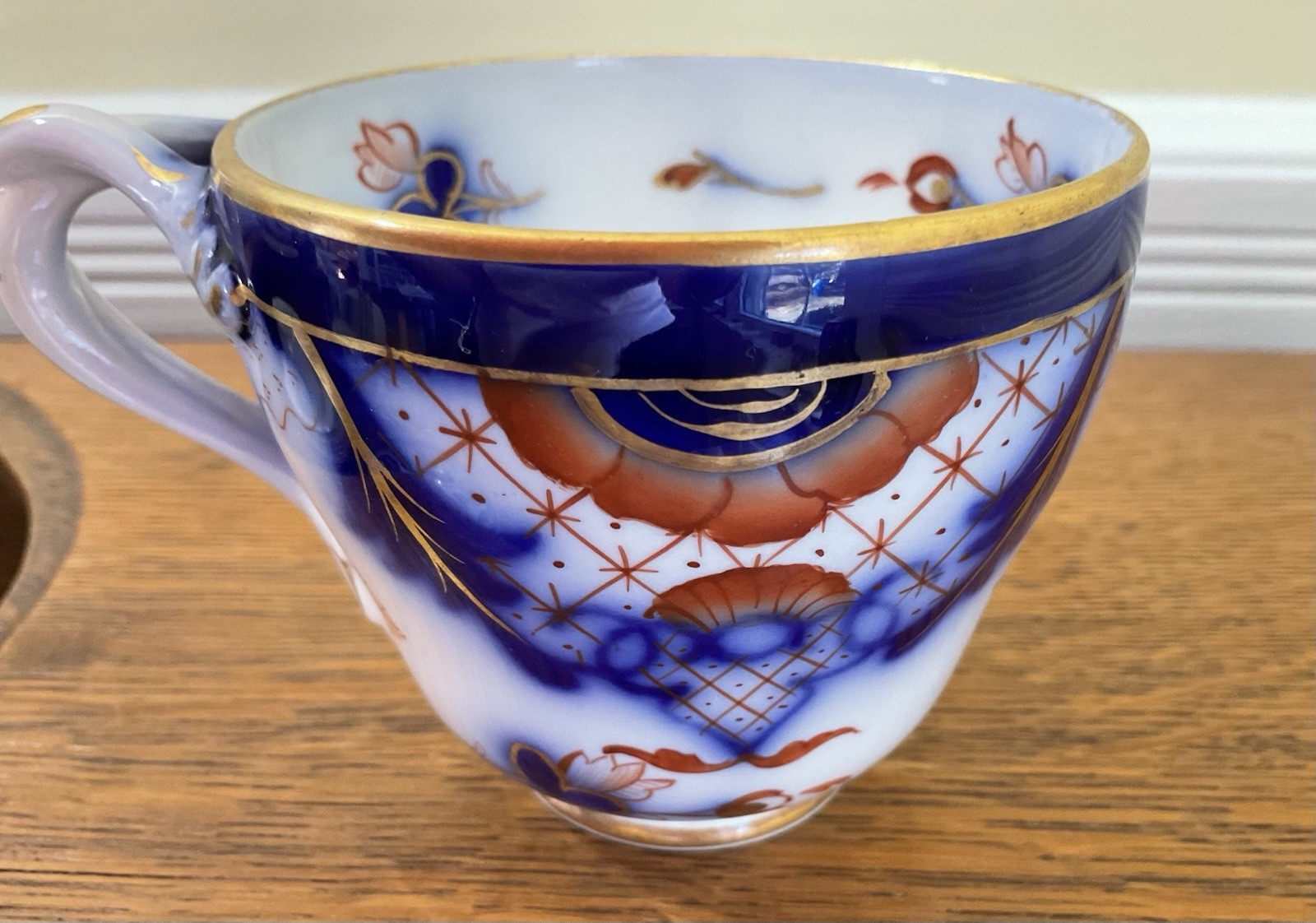
This is an amazing antique teacup and saucer, made in England by Crown Derby, later Royal Crown Derby, about 200 years ago, sometime around the 1820’s into the 1840’s. Amazing because if you think of how easy it is to accidentally break china, how miraculous it is that this cup and saucer has survived that many years and moves from house to house and generation to generation. It must have been a much loved and is a well taken care of set!The backstamps on top of the glaze are red gothic stylized “D” with a crown, used from 1825-1948, during the Robert Bloor period. He started running the factory in 1811 and had the backstamp standardized, from the previous handpainted ones. King George III gave Derby permission to use a crown in their backstamp in 1775. This is the King George who was ruling during the time of the American Revolution.From 1770, the Derby paste included bone ash, which could make this set a white bone china, but I am unsure if it meets the modern definition of bone china. It is definitely a bright white where it is not decorated!Both cup and saucer have smooth edges and the cup has a small foot . At the time this was made, Crown Derby made designs similar to Meissen in Germany, which can be seen in the intricately twisted and split handle that was and still is (I think) made by Meissen. The design is considered Imari, with the cobalt blue and orange design highlighted with gold. The cobalt blue is under glaze and would be considered flow blue, as you can see the blueish areas that bleed out into the white china. Looking at it closely, the blue is underglaze and the orange and gold accents are on top of the glaze. There are 3-leaf cobalt blue clovers outlined in gold with orange leaves and flowers circling the inside of the cup, with a cobalt clover outlined in gold on the cup’s bottom. It appears to me that orange and gold is handpainted, with the intricate details that vary. I have another set in the same pattern, and can see the variations like how many veins in a leaf, and the shapes that vary slightly. How the artist was able to paint those fine details, like the veining on the leaves, especially on the cups interior…well they must have had a very fine paintbrush and a very very steady hand. Transfer printing on china and porcelain was invented in 1757, so the decoration on this set required more skill and time and was therefore more expensive to make. But isn’t it beautiful! Flow blue was very popular in the early 1800’s as potters in Great Britain and Europe discovered the “secret” of making china and started making their own china instead of buying from China. The wealthy were used to Chinese designs, including the use of cobalt blue, so potters started off decorating that way. The early flow blue had designs covering most of the piece in blue, as time went on, there was less blue on the pieces. Sometime in the 1800’s, they discovered that adding lime or chloride of ammonia when making caused the cobalt blue to flow into pottery and this became very popular. The English potters were well known for making flow blue patterns. Around 1915, they stopped making flow blue because the cobalt used came from Saxony in Germany, and World War I cut off that supply to England, so its popularity everywhere faded.The cup is 3 & 1/8 inches in diameter, stands 2 & 3/4 inches tall and holds 3/4 cup. The saucer is 5 & 7/8 inches in diameter and is about 1 & 1/8 inches tall. The set weighs 11.5 ounces.The set is in excellent around 200 year old condition, with no chips but does have very fine crazing throughout that I can see looking with a bright light. I can see a bit more crazing around the handle where the glaze pooled a bit. There is some wear to the orange design in places, but not much. Looking at the saucer at an angle to the light, there are very few light marks in the glaze. There is rub wear to the gold trim and accents, which can be seen in the pictures. The twisted leaf handle has two hairlines on the feathered part on the right side. Because there is blue that has flowed into them, they were present when the cup was fired in the kiln, because blue only flows in china during the high temperatures reached during firing in the kiln! They both appear to have glaze in them and the other smaller one has gold accent on top of it that covers part of it. This can be seen in pictures 21 & 22. Still an absolutely stunning set and a real piece of art! Please zoom in on the pictures and see the 360 degree video for a closer look.I pack with lots of bubble wrap for safe shipping and ship out quickly, within one business day, sometimes same day, and on Saturdays if I can pack it up and get to the Post Office before they close at noon.Any questions, please ask and thanks for looking!!