Jewish ART HAGGADAH Hebrew ISRAEL REBIRTH Independence HERZL Holocaust JUDAICA
Check the listing for details.


| Location | TEL AVIV IL |
| Shipping | USD 25 · Flat |
| Seller |
judaica-bookstore
100% positive · 2773 feedback
|
| Listing | FixedPriceItem · Active |
| Start time | 2023-08-05T08:04:05.000Z |
| End time | 2024-01-05T09:04:05.000Z |
| Time left | PT21H41M3S |
| Restocking Fee | No |
| Return shipping will be paid by | Buyer |
| All returns accepted | Returns Accepted |
| Item must be returned within | 30 Days |
| Refund will be given as | Money Back |
| Country of Manufacture | Israel |
| Handmade | Yes |
| Modified Item | No |
| Country/Region of Manufacture | Israel |
| Religion | Judaism |
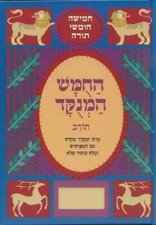
Normal 0 false false false EN-US X-NONE HE DESCRIPTION : UP for sale is a rare FIRST EDITION COPY by DAVID HAREL , The ARTIST who designed this magnificent ARTISTIC Jewish - Judaica Haggadah Shel Pessach . This Strongly Zionist HAGGADAH “ Haggadah Litkumat Israel” ( HAGGADAH for ISRAEL REBIRTH Or REVIVAL or RESURECTION ) is based on the purely traditional text , But each and every such traditional phrase is being accpmpanied by EXQUISITE IMAGERIES which depecit the annals of the JEWISH PEOPLE through its history but mainly the more recents events : The birth of ZIONISM , HERZL , The HOLOCAUST , The IMMIGRATION to ISRAEL , The birth of the STATE of ISRAEL, The 1948 war of Independence ETC. A treasure of GRAPHIC IMAGERIES . Complete traditional text . Throughout illustrated in VIVID COLORS. Excellent most impressive HEBREW . An EXQUISITE piece. Original illustrated HC. SIZE . 9.5 x 13" . Around 70 pp . Excellent quality heavy & thick paper. EXCELLENT pristine condition . Tightly bound. Absolutely clean. Practicaly unused. ( Pls look at scan for accurate AS IS images ) Haggadah will be sent inside a protective rigid packaging. PAYMENTS : Payment method accepted : Paypal & All credit cards.SHIPPMENT : SHIPP worldwide via registered airmail $ 25 . Haggadah will be sent inside a protective rigid packaging . Handling around 5-10 days after payment. Normal 0 false false false EN-US X-NONE HE MicrosoftInternetExplorer4 The Israeli Declaration of Independence (Hebrew: הכרזת העצמאות, Hakhrazat HaAtzma'ut or Hebrew: מגילת העצמאות Megilat HaAtzma'ut), was made on 14 May 1948 (5 Iyar 5708), the day before the British Mandate was due to expire. David Ben-Gurion, the Executive Head of the World Zionist Organization and the chairman of the Jewis Agency for Palestine declared the establishment of a Jewish state in Eretz-Israel, to be known as the State of Israel The event is celebrated annually in Israel with a national holiday Yom Ha'atzmaut (Hebrew: יום העצמאות, lit. Independence Day) on 5 Iyar of every year according to the Hebrew calendar Yom Ha'atzmaut (Hebrew: יום העצמאות Yōm hā-ʿAṣmāʾūṯ lit. "Independence Day") is the national day of Israel, commemorating the Israeli Declaration of Independence in 1948. It is celebrated on 5th of Iyar according to the Hebrew calendar. Yom Ha'atzmaut is preceded by Yom Hazikaron, the Israeli Fallen Soldiers and Victims of Terrorism Remembrance Day Yom Ha'atzmaut centres around the declaration of the establishment of the State of Israel by The Jewish Leadership led by future Prime Minister, David Ben-Gurion, on 14 May 1948. This was declared eight (8) hours before the end of the British Mandate of Palestine, which was due to finish on 15 May 1948. The operative paragraph of the Declaration of the Establishment of State of Israel of 14 May 1948 expresses the declaration to be by virtue of our natural and historic right and on the strength of the resolution of the United Nations General Assembly. The operative paragraph concludes with the words of Ben-Gurion, where he thereby declares the establishment of a Jewish state in Eretz Israel, to be known as the State of Israel. The new state was quickly recognised by the Soviet Union, the United States de facto,and many other countries, but not by the surrounding Arab states, which marched with their troops into the area of the former British Mandate.Most of the official events take place in Israel's capital city Jerusalem, and are broadcast live on television.Yom Ha'atzmaut eveAn official ceremony is held every year on Mount Herzl, Jerusalem on the evening of Yom Ha'atzmaut. The ceremony includes a speech by the speaker of the Knesset (the Israeli Parliament), artistic performances, a Flag of Israel, forming elaborate structures (such as a Menorah, Magen David) and the ceremonial lighting of twelve torches, one for each of the Tribes of Israel. Every year a dozen Israeli citizens, who made a significant social contribution in a selected area, are invited to light the torches. Many cities hold outdoor performances in cities' squares featuring leading Israeli singers and fireworks displays. Streets around the squares are closed to cars, allowing people to sing and dance in the streets.Yom Ha'atzmaut day Reception of the President of Israel for honouring excellence in 120 IDF soldiers. The event takes place in the President's official residence in Jerusalem.International Bible Contest in Jerusalem Israel Prize ceremony in Jerusalem Israel Defense Forces opens some of its bases to the public. Israel Defense Forces parade (1948–1973) Hebrew Song Contest (1960–1980) Israeli families, regardless of religious observance or affiliation, celebrate with picnics and barbecues (known in Israeli slang as a mangal – from the Arabic word منقل meaning "stove"). Balconies are decorated with Israeli flags, and small flags are attached to car windows. Some leave the flags hoisted until after Yom Yerushalayim. Israeli Television channels air the official events live, and classic cult Israeli movies and skits are shown Passover, or Pesach (from: פֶּסַח in Hebrew, Yiddish), /ˈpesaχ/ Pesah, Pesakh, Yiddish: Peysekh, Paysakh, Paysokh) is an important Biblically-derived Jewish festival. Historically, together with Shavuot ("Pentecost") and Sukkot ("Tabernacles"), Passover is one of the three pilgrimage festivals (Shalosh Regalim) during which the entire population of the kingdom of Judah made a pilgrimage to the Temple in Jerusalem. Samaritans still make this pilgrimage to Mount Gerizim, but only men participate in public worship.Passover commences on the 15th of the Hebrew month of Nisan and lasts for either seven days (in Israel) or eight days (in the diaspora). In Judaism, a day commences at dusk and lasts until the following dusk, thus the first day of Passover only begins after dusk of the 14th of Nisan and ends at dusk of the 15th day of the month of Nisan. The rituals unique to the Passover celebrations commence with the Passover Seder when the 15th of Nisan has begun. In the Northern Hemisphere Passover takes place in spring as the Torah prescribes it: "in the month of [the] spring" (בחדש האביב Exodus 23:15). It is one of the most widely observed Jewish holidays. The Jewish people celebrate Passover as a commemoration of their liberation over 3,300 years ago by God from slavery in ancient Egypt that was ruled by the Pharaohs, and their birth as a nation under the leadership of Moses. It commemorates the story of the Exodus as described in the Hebrew Bible especially in the Book of Exodus, in which the Israelites were freed from slavery in Egypt. In the narrative of the Exodus, the Bible tells that God helped the Children of Israel escape from their slavery in Egypt by inflicting ten plagues upon the ancient Egyptians before the Pharaoh would release his Israelite slaves; the tenth and worst of the plagues was the death of the Egyptian first-born. The Israelites were instructed to mark the doorposts of their homes with the blood of a slaughtered spring lamb and, upon seeing this, the spirit of the Lord knew to pass over the first-born in these homes, hence the name of the holiday.There is some debate over where the term is actually derived from. When the Pharaoh freed the Israelites, it is said that they left in such a hurry that they could not wait for bread dough to rise (leaven). In commemoration, for the duration of Passover no leavened bread is eaten, for which reason it is called "The Festival of the Unleavened Bread".Thus Matzo (flat unleavened bread) is eaten during Passover and it is a symbol of the holiday. The Passover Seder (Hebrew: סֵדֶר order, arrangement"; Yiddish: Seyder) is a Jewish ritual feast that marks the beginning of the Jewish holiday of Passover. It is conducted on the evenings of the 14th day of Nisan in the Hebrew calendar, and on the 15th by traditionally observant Jews living outside Israel. This corresponds to late March or April in the Gregorian calendar. The Seder is a ritual performed by a community or by multiple generations of a family, involving a retelling of the story of the liberation of the Israelites from slavery in ancient Egypt. This story is in the Book of Exodus (Shemot) in the Hebrew Bible. The Seder itself is based on the Biblical verse commanding Jews to retell the story of the Exodus from Egypt: "You shall tell your child on that day, saying, 'It is because of what the LORD did for me when I came out of Egypt.'" (Exodus 13:8) Traditionally, families and friends gather in the evening to read the text of the Haggadah, an ancient work derived from the Mishnah (Pesahim 10).The Haggadah contains the narrative of the Israelite exodus from Egypt, special blessings and rituals, commentaries from the Talmud, and special Passover songs. Seder customs include drinking four cups of wine, eating matza, partaking of symbolic foods placed on the Passover Seder Plate, and reclining in celebration of freedom. The Seder is performed in much the same way by Jews all over the world. The Haggadah (Hebrew: הַגָּדָה, "telling", plural: Haggadot) is a Jewish text that sets forth the order of the Passover Seder. Reading the Haggadah at the Seder table is a fulfillment of the Scriptural commandment to each Jew to "tell your son" of the Jewish liberation from slavery in Egypt as described in the Book of Exodus in the Torah. ("And thou shalt tell thy son in that day, saying: It is because of that which the LORD did for me when I came forth out of Egypt. " Ex. 13:8) Sephardi and Mizrahi Jews also apply the term Haggadah to the service itself, as it constitutes the act of "telling your son." ebay41