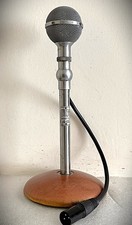
Shure Brothers B-162-4 Wollensak Desktop Dynamic Microphone
Check the listing for details.


| Location | McKinleyville, California US |
| Shipping | USD 15 · Flat |
| Seller |
video_general
100% positive · 3665 feedback
|
| Listing | FixedPriceItem · Active |
| Start time | 2023-09-04T11:48:38.000Z |
| End time | 2024-02-04T12:48:38.000Z |
| Time left | P6DT22H57M39S |
| All returns accepted | ReturnsNotAccepted |
| Brand | Shure |
| Type | Vintage Microphone |
| Model | B-162-4 |
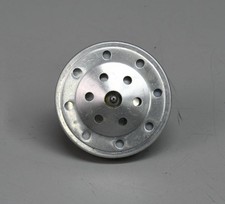
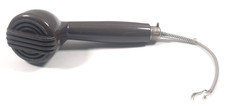
This is a Shure B-162-4 Dynamic Microphone hiding in a Wollensak case. That case is very retro vintage looking and it has a standard microphone screw in adapter, on the bottom, so that it will work with virtually any mic stand; from desktop to boom stand. This microphone comes from the equipment compliment of a Wollensak T-1515 tape recorder. They make great harp mics. This one is in excellent working condition. If you need more pictures or information, please let me know. BTW, while researching this microphone I ran into the information below. It took me almost an hour to figure out that it was BS, but I thought that the serious mic users might just enjoy it so it is included below Shipping will be by UPS Ground. International shipping will be via USPS Priority Mail. The buyer assumes all responsibility for insurance claims and, any return shipping fees must be paid by the buyer. EB-1022 So it’s an old tape recorder microphone, “So what?,” you say. Here’s what: (I did not write this, it is from my research, it came from gearspace, written by contributor capnreverb:) Dieder Wollensak was the leader tech/engineer at Neumann before the fall of Berlin. You may have heard of the Gefell split, which basically took the old designs and improved upon them. Wollensak was stuck in the Eastern Block but kicked out of Gefell due to some rumored sexual impropriety, or political leanings depending on who's doing the history. So, Dieder W was stuck to his own devices and came up with the Wollensak mic around 1963 after about 15 years of hardcore tinkering. This may be the greatest unknown mic outside of the "know" circles. Unfortunately, Wollensak committed suicide after the initial production of about 5000 mics, and the original schematics were burned before he hanged himself. He was distraught over the fact that his greatness was being marginalized and the 15 years of dire poverty did not help. So, let’s look at the mic. For starters, there is virtually no self noise. This is due to its cadmium bromide resistors, FET triode reduced algorithm transistors, and mercury sputtered diaphragm. The mercury (his own breakthrough) sputtered diaphragm gives the incoming sound source an almost liquid buoyancy. The fact that mercury is a liquid (made stable by Dieder's sputtering technique) makes all incoming energy (sound) elastic, therefore reproducing more accurately the sound source. So, in a way, it is almost like a ribbon mic in the natural give and take of energy. The advanced resistors and transistors offer an exceptional electronic translation of the natural output of the mercurial diaphragm. While it is a cardioid mic, it's off axis response is like god had planned it that way. Imagine the fullness of an omni, but with the precision of a hypercardioid. Freakin' mind-bending!!!! A lot of mics sound good on one vocal style, but not another. This is never a problem with the Wollensak. Baritone opera to the highest note of the sopranina, from Tom Waits gravel to Rap exclamation this mic excels. Many of you may have struggled with the soprano sax in terms of the right mic. No problem for that horn. Upright bass? Ron Carter owns 2 of them! John Cage and Morton Feldmann would only use these for their recordings. They were especially fond of how quiet these mics are. Steve Albini swears by them. John Lennon and Phil Spector used these mics exclusively for the Imagine LP. This was George Martins favorite mic. All of you folks have it wrong about Bono using the sm57/58 for his voice. According to Brian Eno who has worked on most of their albums, it's the Wollensak. Rudy Van Gelder? Of course. Elvin Jones said it was Rudy's go to mic on the drums. Due to its mercury diaphragm it takes to compression and auto tune like no other microphone. You can put it in front of a Marshall cab at 10 and have no SPL issues. The mics that National Geographic uses to record whale songs are just a modified version of this mic. These really are the secret weapon of engineer's in the "know".