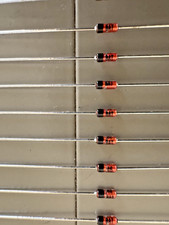
1201-LAB Mr Circuit Lab 2 PRACTICAL ELECTRONICS TROUBLESHOOTING with MULTIMETER
Check the listing for details.


| Location | San Luis Obispo, California US |
| Shipping | Free shipping (check listing for details) |
| Seller |
mrcircuit23
99.8% positive · 4221 feedback
|
| Listing | FixedPrice · Active |
| Restocking Fee | No |
| Return shipping will be paid by | Buyer |
| All returns accepted | Returns Accepted |
| Item must be returned within | 30 Days |
| Refund will be given as | Money Back |
| Brand | Mr Circuit Technology |
| Type | Basic Electronics Course |
Are you looking for a way to learn, study, or teach Electronics Troubleshooting? This Mr Circuit Lab is perfect for you. Whether at home on in the classroom, this lab is ideal. It is low-cost, reliable, hands-on, reusable, and durable. And, it comes with a free CAREER CERTIFICATE. When you order this lab, you will receive lab parts for experiments, printed lessons, a link to the online tutorial lesson presentations given by an electronics instructor. There are also online practice quizzes included with this lab. In addition, upon completion of this lab, you will receive a signed Certificate of Electronics training. Educational Tutorial Lab for:S.T.E.M. --- S.T.E.A.M. --- Automotive --- HVAC --- Avionics --- Electronics --- Robotics---Arduino, etc.With this lab, you will work with formulas for Ohm's Law, Watts Law, calculate the equivalent resistance of resistors in series and parallel, use a multimeter to determine the ohms of resistors in series and parallel, calculate resistor wattage, calculate resistor values in LED circuits, calculate and measure current in series and parallel circuits, calculate and measure voltage drops, and more.You will get practice reading resistor values, current, and voltage on the display of the Digital Multimeter. You will also get more practice using a solderless circuit board to build electronic circuits. (See the whole Skill Set below.). We have trained many technical people and one of their biggest needs was to know how to use and interpret the readings on a multimeter. This knowledge and experience will open up more opportunities at employment and entrepreneurship.All components necessary for the experiments are included. No extra tools are needed. The lab includes a 9 volt battery power source, a solderless circuit board to build circuits, 10 colored 5mm LEDs (red, green, yellow, blue, clear) and 14 resistors for testing and measuring and a multifunction Digital Multimeter. Here is the list of topics covered in the Mr. Circuit MULTIMETER FUNDAMENTALS Lab 1201-P "Ohm's Law and More!"1 Learn schematic symbols for the components in this lab 2 Learn about batteries and cells and their schematic symbols 3 Learn about an LED and its schematic symbol 4 Learn to use the Resistor Color Code for nominal values 5 Learn to use the Color Code with ±5% Resistors 6 Learn to use the Color Code with ±1% Resistors 7 Take inventory of the electronic parts used in this lab 8 Learn how to build a Simple Series circuit 9 Learn about the components used in a Simple circuit 10 Learn how to connect components in a Simple circuit 11 Learn the construction of a Solderless Circuit Board (SCB) 12 Learn how to build a Simple Circuit on a SCB 13 Build two LED circuits and compare the LED brightness 14 Learn Ohm's Law and how to use it. E = I x R 15 Learn to use Ohm's Law with resistors in Series 16 Learn to use Ohm's Law with resistors in Parallel 17 Learn that all LEDs do not have the same voltage drop 18 Learn to calculate the resistance needed in a circuit with LEDs 19 Learn how to connect multiple LEDs in a circuit 20 Learn how to use a Digital Multimeter (DMM) 21 Learn unit Conversion - Amps, mAmps, and uAmps 22 Learn how to measure current with a DMM 23 Learn about a Series circuit versus the current in the circuit 24 Use DMM to Verify consistent current flow in a Series circuit 25 Build a circuit with 470 ohms and measure the current 26 Build a circuit with 1k ohms and measure the current 27 Build a circuit with 3.3k ohms and measure the current 28 Build a circuit with 6.8k ohms and measure the current 29 Learn how to measure DC Volts with a DMM 30 Use Ohm's Law and Watt's Law to calculate wattageHere is the SKILL SET for the Mr. Circuit MULTIMETER FUNDAMENTALS Lab 1201-P "Ohm's Law and More!"Identify the physical appearance and schematic of a single cell, a multicell battery, an LED, and a resistor.Explain how cells connected in series form a multicell device called a battery and draw the schematic..Describe the schematic symbol for an LED, show the polarity with Anode and Cathode.Describe the purpose of the ‘flat side’ and the ‘short lead’ on the LED in reference to the Cathode..Understand that the long leg of the LED is the positive side or the Anode.Understand that the beveled edge on an LED is the way to find the Cathode if the LED is in a wired circuit.Understand how to use the Resistor Color Code to identify resistor values for both 5% and 1% resistors.Take inventory of electronic components and report any discrepancies.Draw a simple circuit schematic with symbols and label them including their for polarity.Build a basic circuit using the solderless circuit board, the LED, various resistors and a 9-volt battery. Match the physical component to their schematic symbol.Construct a circuit using a schematic diagram.Understand the construction of a solderless circuit board.Use Ohm’s Law to calculate voltage, current, and resistance.Calculate the equivalent resistance of two resistors in series.Calculate the equivalent resistance of two resistors in parallel.Identify various voltage drops across different colored LEDs.Calculate the additional resistance needed in an LED circuit based on voltage of the power source.Connect multiple LEDs in a parallel circuit.Measure a variety of values of ohms with a digital multimeter.Interpret the reading on the multimeter display in the Ohms function.Set up a multimeter to check the current flowing in a circuit.Connect the multimeter to a circuit and measure the current.Break a series circuit and connect the multimeter to measure the current.Explain that the current flowing in a series circuit is the same amount through each component.Explain the effect of the amount of current flowing in an LED circuit on the brightness of the LED.Set up a multimeter to measure DC voltages.Measure DC voltage and voltage drops across components in an active circuit.Calculate the minimum wattage needed in a resistor.Build a future in Electronics. Order today. All orders are shipped the business day we receive them.