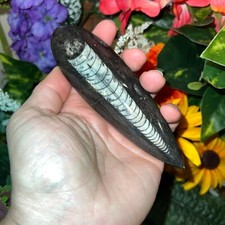
Mazon Creek Fossil Tully Monstrum , Large eye bar, Pit 11 ex MWF Collection
Check the listing for details.


| Location | Peoria, Illinois US |
| Shipping | Free shipping (check listing for details) |
| Seller |
freepineland574
100% positive · 114 feedback
|
| Listing | FixedPriceItem · Active |
| Start time | 2024-04-07T16:55:08.000Z |
| End time | 2024-09-07T16:55:08.000Z |
| Time left | P16DT5H1M39S |
| Restocking Fee | No |
| Return shipping will be paid by | Buyer |
| All returns accepted | Returns Accepted |
| Item must be returned within | 30 Days |
| Refund will be given as | Money Back |
Mazon Creek Fossil Tully Monstrum , Large eye bar, Pit 11 ex MWF CollectionMeasures 4 1/2 x 1 3/4 inches. Complete Nodule. Ex MWF Collection. Merrill W. Foster, professor of geology and paleontology, emeritus. He retired from Bradley University in Peoria,IL in 2016 after 47 years, during which he won the Putnam Award for Excellence in Teaching and Rothberg Award for Professional Excellence. Dr. Foster’s publications were referenced in Jack Wittry’s “The Mazon Creek Fossil Fauna”, specifically in regards to Reticulomedusa greenei and Essexella asherae. Dr. Foster also published two papers in the work “Mazon Creek Fossils” edited by Matthew Nitecki. These were “Soft-Bodied Coelenterates in the Pennsylvanian of Illinois” and “A Reappraisal of Tullymonstrum gregarium.” The Mazon Creek fossil beds are a conservation lagerstätte found near Morris, in Grundy County, Illinois. The fossils are preserved in ironstone concretions, formed approximately 309 million years ago in the mid-Pennsylvanian epoch of the Carboniferous period. These concretions frequently preserve both hard and soft tissues of animal and plant materials, as well as many soft-bodied organisms that do not normally fossilize. The quality, quantity and diversity of fossils in the area, known since the mid-nineteenth century, make the Mazon Creek lagerstätte important to paleontologists, in attempting to reconstruct the paleoecology of the sites.The locality was declared a National Historic Landmark in 1997. Free priority shipping.